

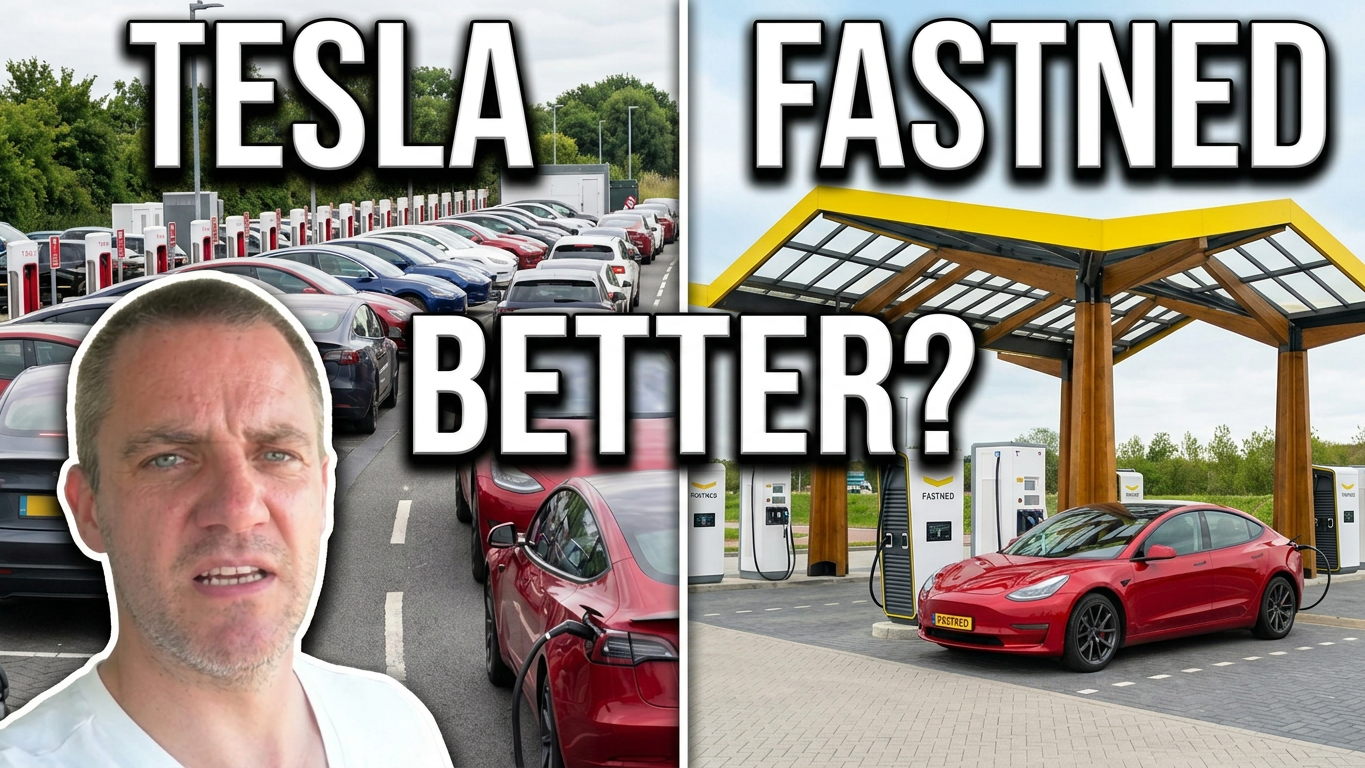
Fastned Autocharge review – the perfect Tesla Supercharger alternative for European road trips
In this video I show you how to enable Autocharge on the Fastned network with a Tesla Model 3 Performance. Just plug in and charging starts automatically – no app, no card, no waiting.
✅ How to activate Fastned Autocharge step-by-step
✅ Real plug-and-charge demonstration
✅ Charging speed, reliability & app experience
✅ Pricing (ad-hoc vs subscription)
✅ Pros & cons vs Tesla Superchargers
✅ Coverage in Netherlands, Germany, France, UK, Italy & more
How to sign up and get Fastned on your smartphone
Fastned advantages and disadvantages over Tesla Superchargers (comparison)
Fastned and Tesla Superchargers are two of the highest-rated fast-charging networks in Europe. While both provide ultra-fast DC charging and high reliability, they follow different design philosophies and business models.
Key Comparisons
| Feature | Fastned | Tesla Superchargers |
|---|---|---|
| Primary Footprint | Western/Northern Europe (expanding EU-wide) | Global (extensive North American & European density) |
| Max Charging Power | Up to 300–400 kW (800V support) | 250 kW (V3) to 325–350 kW (V4) |
| Weather Protection | Iconic yellow roofs/canopies with solar panels | Mostly open-air (rarely covered) |
| Payment Options | Contactless card, app, charge cards, Autocharge | Tesla App, Plug & Charge (Tesla), RFID/Card readers (select V4s) |
| Cable / Bay Layout | Drive-through or wide stalls; long cables | Short cables; optimized for Tesla charge port placement |
| Average Pricing | Higher base rate (€/kWh) | Typically lower per kWh (especially for Tesla owners/subscribers) |
Advantages of Fastned over Tesla Superchargers
- Better Weather Protection & Lighting: Fastned’s signature yellow stations feature large covered canopies equipped with bright lighting and solar panels. This makes charging in rain, snow, or at night significantly more comfortable compared to most exposed Supercharger locations.
- Superior 800V Architecture Performance: Fastned’s 300–400 kW hardware delivers maximum charging speeds to 800V vehicle architectures (e.g., Hyundai Ioniq 5/6, Kia EV6, Porsche Taycan, Audi e-tron GT). While Tesla Supercharger V3 stalls are limited to 400V—forcing 800V cars to use voltage step-up converters that cap charging speeds—Fastned lets these EVs charge at full speed.
- Driver-Friendly Station Layouts: Many Fastned hubs are built with drive-through bays similar to traditional petrol stations. Cables are significantly longer, making it easier for non-Tesla EVs with charge ports on different corners (e.g., front-left or rear-right) to park and plug in without blocking adjacent stalls.
- Flexible Payment Methods: Fastned supports direct bank/credit card contactless payments (NFC terminals on stalls), traditional MSP/charge cards, the Fastned App, and Autocharge (Plug & Charge equivalent for CCS cars). Tesla Superchargers historically require using the Tesla App for non-Tesla drivers.
- Highway Rest-Stop Locations: In markets like the Netherlands and Germany, Fastned stations are frequently located directly inside official highway service areas, whereas Superchargers are often built slightly off highway exits in hotel or retail park parking lots.
Disadvantages of Fastned compared to Tesla Superchargers
- Higher Charging Costs: Fastned’s pay-as-you-go ad-hoc rates are generally higher per kWh compared to Tesla Superchargers. Even with Fastned’s monthly Gold Member subscription, Tesla Supercharger pricing (for both Tesla owners and non-Tesla monthly subscribers) often remains cheaper.
- Smaller Network Scale & Fewer Stalls per Location: While Fastned is expanding rapidly across Europe, Tesla operates a vastly larger global network. A Fastned location typically features 4 to 12 charging stalls, whereas Tesla Supercharger hubs frequently feature 12 to 30+ stalls, significantly reducing the likelihood of waiting during peak travel periods.
- Tesla Vehicle Integration: For Tesla drivers, Superchargers offer frictionless route planning. Navigating to a Supercharger via the in-car screen automatically precondition the battery for optimal fast charging and provides live stall availability. Charging at Fastned requires manual preconditioning or third-party route planners (like ABRP).
- Geographic Availability: Fastned is primarily focused on Western and Northern Europe (the Netherlands, Germany, UK, France, Belgium, Switzerland, etc.). Outside of these regions, coverage drops off, whereas Tesla Superchargers span North America, Europe, Asia-Pacific, and beyond.
Should you use Fastned or Tesla Supercharger?
- Choose Fastned if you drive an 800V EV, prefer covered stations out of the weather, value direct card payments/longer cables, or are charging at highway service plazas.
- Choose Tesla Superchargers if you prioritize lower cost per kWh, larger station capacity (less queuing), integrated Tesla software routing, or seamless plug-and-play convenience.
Feedback
What’s your experience charging your electric car at Fastned fast charging stations or at alliance partners like Electra? Or do you only use Tesla Superchargers and are even willing to wait for them during high traffic periods? Check out also my other tips how to clean your Tesla touch screen safe and how to wax your car for the ultimate Tesla shine and protection. Please help grow my YouTube channel by subscribing or becoming a premium channel member, so I can test, review and compare new products. Please support my channel and use my Tesla promo code for a big discount on your new car or free supercharger Miles.