

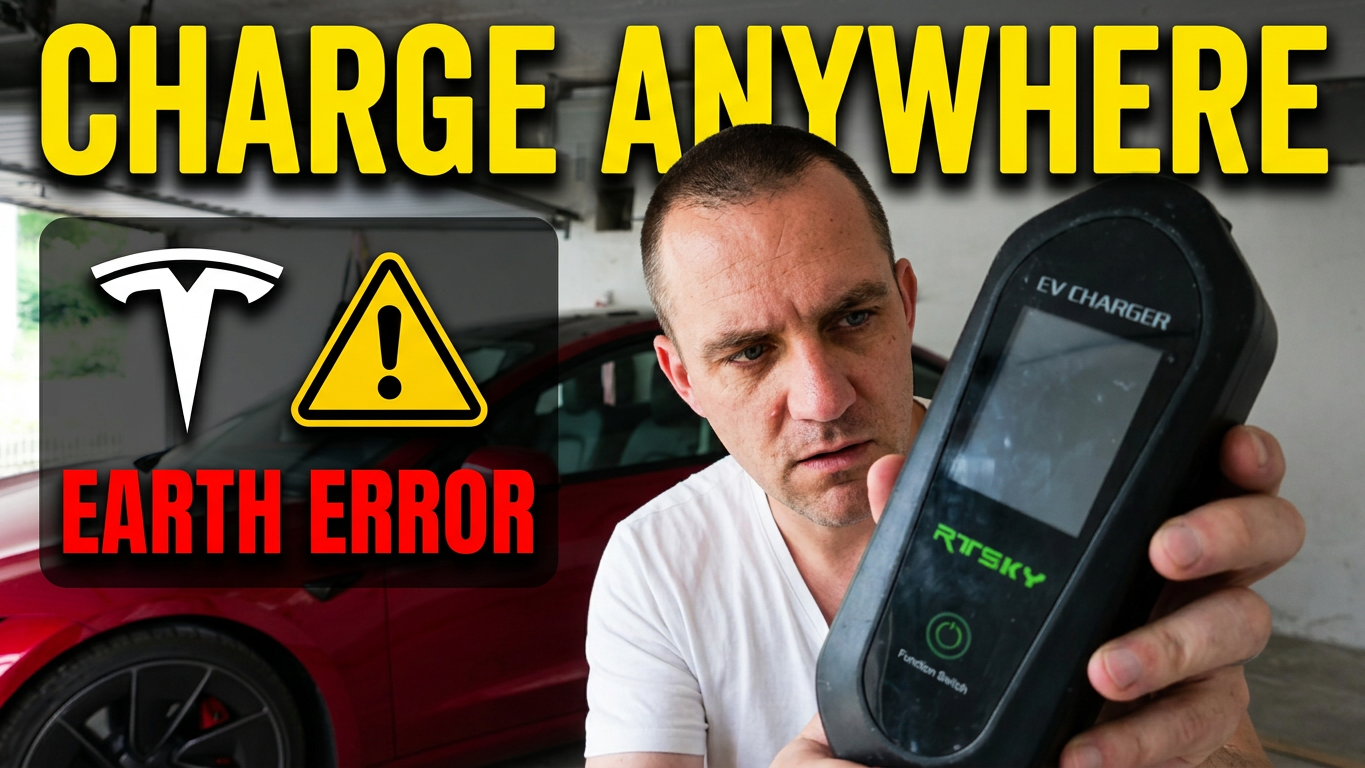
How to charge Tesla or any EV on ungrounded sockets in emergency cases
How to bypass the ground/earth charging error on Tesla Mobile Connector and other EV portable chargers so you can force charge on any socket — especially ungrounded or unearthed outlets in old houses, rural areas, cabins, and on road trips. In this video I show why I don’t take the OEM Tesla Mobile Connector on emergency or vacation charging and instead use a portable Type 2 charger (RTSKY) that lets you turn off ground protection when needed.
Exact product I use (full demo in video)
Should you charge your EV on sockets without earth & grounding?
No, you should strictly avoid charging an electric vehicle (EV) on a socket without a proper earth/ground connection. In fact, almost all standard EV portable chargers (Mode 2 cable / “granny charger”) will detect the missing ground line immediately and refuse to initiate charging, displaying a red fault or ground error LED.
Key Reasons Why EV Charging Requires Grounding
- Severe Electric Shock Hazard: EV charging uses high continuous power (typically 10A–16A over many hours). The car’s outer chassis is metal. If an insulation breakdown occurs, the earth connection safely channels leakage current to the ground to trip the breaker. Without earth, touching the car’s body or cable could result in a lethal electric shock.
- Continuous Safety Monitoring (Pilot Signal): Modern EV charging systems rely on continuous communication between the car and the control box (ICCB). Ground continuity is part of this safety handshake. If the control box detects high ground resistance or no ground at all, it blocks power flow.
- Protective Device Failure: EV charging setups require an RCD / GFCI (Residual Current Device) to protect against DC and AC leakage currents. While an RCD measures current imbalance, the ground wire provides the initial safe path for small continuous stray currents, preventing sensitive protection circuits from behaving unpredictably.
- Fire & Overheating Risk: Ungrounded outlets are almost always older electrical installations with light-gauge, aged wiring. Drawing 2.3 kW to 3.7 kW continuously through an old two-wire circuit creates a high risk of contact resistance, arc faults, and melted sockets.
What Should You Do Instead?
- Use a Dedicated Home Wallbox: Have a qualified electrician install a dedicated EV charging station fed directly from your main electrical panel with a verified earth line, proper cable cross-section, and appropriate RCD/circuit breaker protection.
- Upgrade the Receptacle: If using a standard socket, ensure a certified electrician verifies or installs a properly grounded, high-duty outlet (such as a heavy-duty Schuko rated for continuous load or a blue CEE 16A socket).
- Never Bypass Safety Features: Never use “cheater” adapters, remove ground pins, or attempt to disable the ground monitor on portable charging cables.
What are sockets without earth and ground installed?
Sockets without earth/ground (commonly called ungrounded sockets or two-prong outlets) are electrical receptacles wired with only two conductors: Live (Hot) and Neutral. They lack a dedicated grounding path to earth.
Key Characteristics & How They Work
- Two-Wire System: Current flows from the main panel through the Live wire to power the device, then returns via the Neutral wire.
- No Ground Path: There is no third wire (earth/ground) to handle stray electrical currents.
- Physical Design: In North America, these appear as standard two-prong outlets without the round hole. In Europe, they appear as Europlug (Type C) sockets lacking side grounding clips (like standard Schuko / Type F sockets have).
Why Are They Found in Homes?
- Older Building Codes: Before the 1960s–1970s, building standards in many countries did not require a grounding wire for standard household circuits.
- Double-Insulated Devices: Modern ungrounded sockets are still permitted in specific applications for Class II (Double Insulated) appliances. Devices like cell phone chargers, plastic-bodied lamps, and television power adapters do not use or require a ground pin because their plastic casing prevents metal parts from becoming energized.
Primary Risks of Ungrounded Outlets
- Electric Shock Hazard: If an internal live wire inside an appliance with a metal chassis comes loose, the entire metal casing becomes energized. Touching it completes the circuit to the ground through your body.
- Infective Surge Protection: Surge protector power strips rely directly on the earth line to divert excess voltage spikes away from electronics. Without ground, surge protectors act only as basic extension blocks and cannot shield sensitive equipment.
- Fire Risk: Fault currents or arcing inside the wall or connected equipment have no safe discharge path, which can cause heat buildup in aging wire insulation.
Safe Ways to Upgrade or Manage Ungrounded Outlets
1. Install a GFCI/RCD Outlet (No Ground Required)
- Replacing an ungrounded socket with a GFCI (Ground Fault Circuit Interrupter) or RCD (Residual Current Device) provides shock protection even without a ground wire.
- It detects current imbalances (e.g., electricity leaking through a human body) and trips within milliseconds. Electrical codes (such as NEC) require these to be labeled “No Equipment Ground”.
2. Rewire the Circuit
- The ultimate long-term solution involves pulling new three-wire cable (Live, Neutral, and Ground) from the breaker panel to the socket box.
3. Avoid Hazardous “Fixes”
- Do not cut off the ground pin on a 3-prong plug to force it into a 2-prong socket.
- Avoid cheater adapters (3-to-2 prong adapters) unless the small metal tab is explicitly tied to a verified grounded junction box.
- Never create a “Bootleg Ground” (bridging Neutral to Ground at the receptacle). This is illegal and creates a severe electrocution hazard if the neutral wire breaks upstream.
Feedback
Check out my full review of the RTSKY charger here. Have you ever been stuck because of a ground/earth fault on your mobile EV charger? Which portable Type 2 charger do you use? Please help grow my YouTube channel by subscribing or becoming a premium channel member, so I can test, review and compare new products. Please support my channel and use my Tesla promo code for a big discount on your new car or free supercharger Miles.