

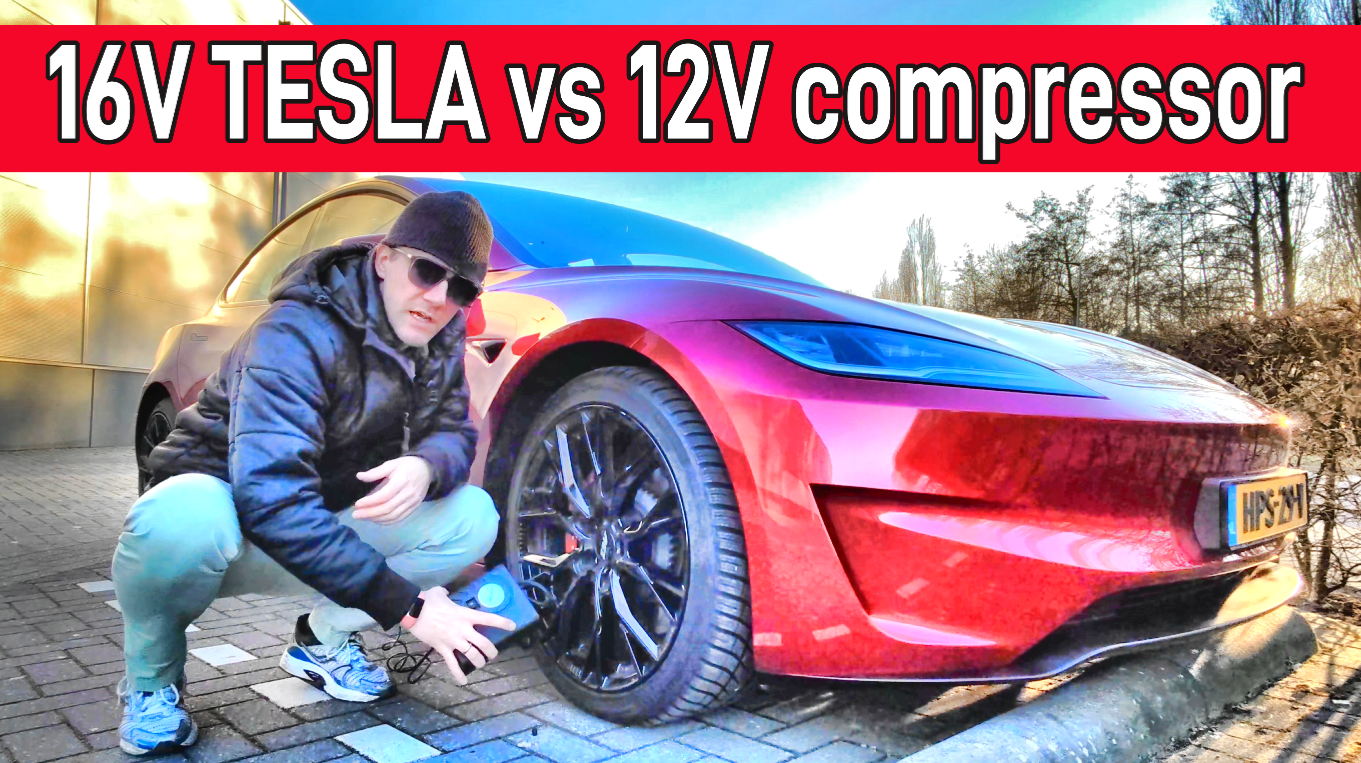
Test and review of 12V Slime compressor on a 16V Tesla battery
Can the new Tesla 16V lithium-ion starter battery power your old 12V car accessories? In this video, I put a Slime 12V tire compressor to the test to see if the higher voltage causes any issues during a full tire inflation. Many Tesla owners are worried that the move from a traditional 12V lead-acid battery to the new 16V system in newer Model 3, Model Y, Model S, and Model X vehicles will break their legacy accessories like vacuum cleaners, inverters, and air pumps.
Will 12V car gadgets and accessories work on a 16V tesla battery?
The short answer is mostly yes.
Since late 2021, Tesla switched from the traditional 12V lead-acid battery to a 16V Lithium-ion low-voltage battery. While the car’s manual refers to the outlets as “12V,” the actual output is typically between 15.5V and 15.8V.
Here is how common gadgets handle that extra voltage:
1. What usually works fine
Most car accessories are designed to handle more than 12V because a traditional gas car’s alternator actually puts out 14.2V to 14.7V while driving.
- Phone Chargers: High-quality USB-C and Lightning car chargers almost always have a wide input range (typically 12V–24V) and won’t have any issues.
- Tire Inflators: Most portable compressors (like Slime or generic brands) work fine, though they might run slightly faster/louder because of the higher voltage.
- Simple Heated Blankets/Seats: These are resistive loads; they will just get hot a little faster than usual.
2. What might have issues
- Cheap/Old Dashcams: Some older or very inexpensive dashcams are strictly rated for 12V. 16V can cause them to overheat or blow an internal fuse.
- 12V Refrigerators/Coolers: While many modern car fridges (like Dometic or Alpicool) are “dual-voltage” (12/24V) and handle 16V perfectly, some cheaper models have an “Over-Voltage Protection” error and will refuse to turn on.
- Small Power Inverters: Many portable 12V-to-110V/220V inverters have a safety cutoff at 15V. If you plug one in, it might just beep and shut down immediately.
3. Quick Checklist Before You Plug In
- Check the Label: Look for an “Input” range on the gadget. If it says 12V–24V, you are 100% safe. If it says 12V ± 10%, it might struggle or fail.
- Tesla’s Own Warning: In the Owner’s Manual for newer models, Tesla explicitly states: “Note: For vehicles manufactured after approximately November 2021, power inverters plugged into the low voltage power socket must support 16V DC input to function.”
Feedback
What are your favorite 12V car accessories? Let me know in the comments. Please help grow my channel by subscribing or becoming a premium channel member, so I can test, review and compare new products. Please support my channel and use my Tesla promo code for a big discount on your new car or free supercharger Miles.